ControlAlign™ · Industrial Thermodynamic Intelligence — LNG · CCS/CCUS · Refining · Petrochemicals · Thermal Power · Biomass · Industrial Steam & Process Heat
PlatformHow It WorksMethodologyTechnologyCarbon IntelligenceSample DiagnosticDoctrineResourcesAboutFAQContactRequest Assessment →
Operational Architecture · ControlAlign™

How ControlAlign Works

Historian-derived operational intelligence for reconstruction, stabilisation, and optimisation of thermal performance. A deterministic, audit-grade reference-alignment layer for utility-scale thermal assets.

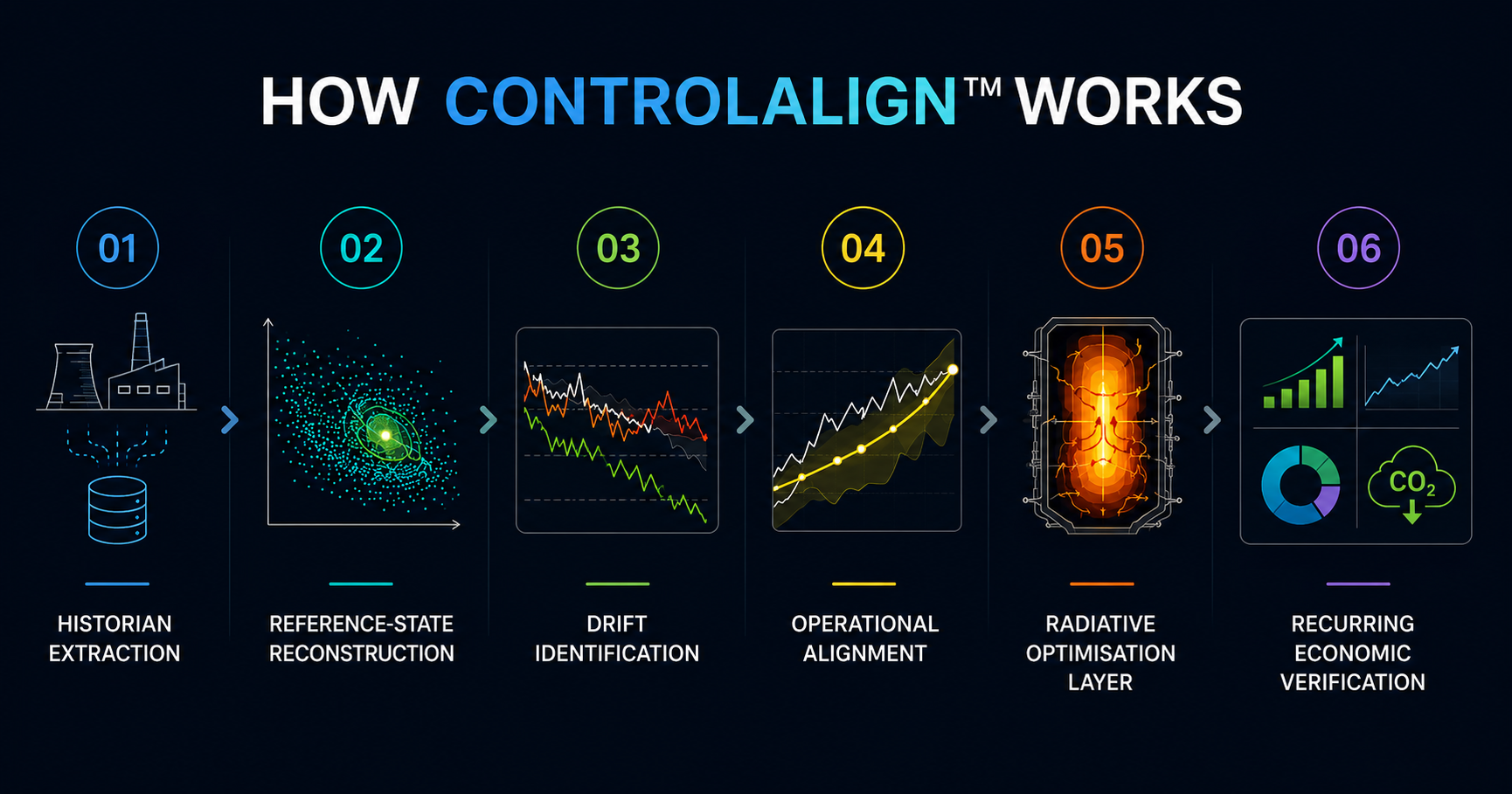
ControlAlign workflow: Historian Extraction, Reference-State Reconstruction, Drift Identification, Operational Alignment, Radiative Optimisation Layer, Recurring Economic Verification

ControlAlign™ reconstructs the plant's own historical operating behaviour to identify superior thermal-performance states, quantify operational drift, align operation toward proven conditions, and continuously verify recurring economic recovery.

Historian Extraction

Read-only retrieval of plant operating history from the existing historian — no DCS modification, no instrumentation change, no outage.

ControlAlign™ ingests the plant's own time-series operating record at native resolution. Load, fuel, air, steam, and temperature signals are reconciled into a continuous operational record forming the deterministic basis for every downstream stage.

  • Native-resolution historian export
  • Read-only, non-intrusive integration
  • No control-system dependency
  • Audit-traceable data provenance

Reference-State Reconstruction

The plant's own historically demonstrated operating states are reconstructed across the full load and operating envelope.

Reference operation is not a vendor benchmark and not a theoretical target. It is the plant's own best demonstrated thermal-performance behaviour, reconstructed directly from its operating record and organised by load band and operating regime.

  • Plant-native reference envelope
  • Load-band stratified
  • Historically demonstrated, not theoretical
  • Operator-traceable

Drift Identification

Deviation between current operation and the unit's own reference state is quantified across the operating envelope.

Drift is expressed against demonstrated capability, not against generic targets. Each drift signature is decomposed by operating condition so that recoverable performance is separated from genuine load- or fuel-related effects.

  • Drift expressed in fuel-value terms
  • Decomposed by operating regime
  • Separated from load/fuel effects
  • Auditable against historian record

Operational Alignment

Operating practice is aligned toward the plant's own demonstrated reference states without disturbing existing control architecture.

Alignment guidance is delivered as operator-actionable reference envelopes rather than control-loop modifications. The plant moves toward its own proven operating states using its existing crew, existing DCS, and existing procedures.

  • Operator-actionable reference envelopes
  • No control-loop modification
  • Compatible with existing procedures
  • Stabilisation before optimisation

Radiative Optimisation Layer

A dedicated layer focused on furnace radiative behaviour and heat-transfer effectiveness across the operating envelope.

The radiative layer addresses the dominant heat-transfer mechanism inside utility-scale boilers. It characterises radiative coupling between combustion and water-wall absorption, identifies recoverable radiative-performance states the plant has historically achieved, and guides operation toward conditions in which heat transfer is more completely realised. Implementation methodology, internal indices, and inference logic remain proprietary.

  • Furnace radiative behaviour
  • Heat-transfer effectiveness
  • Combustion-to-absorption coupling
  • Recoverable radiative state

Recurring Economic Verification

Recovered performance is continuously verified in fuel-value and economic terms against the historian record.

Recovery is not declared once; it is verified on a recurring basis. Each verification cycle reconciles current operation against the reconstructed reference state, expresses the result in fuel and economic terms, and produces an audit-aligned operational record for plant, fleet, and sponsor review.

  • Fuel-value and economic terms
  • Recurring verification cycles
  • Audit-aligned reporting
  • Plant, fleet, and sponsor visibility
Scale Architecture

From Unit Intelligence to Fleet Governance

ControlAlign™ is deployed at the level of an individual boiler or generating unit, where reference-state reconstruction and operational alignment produce recoverable performance against the asset's own demonstrated capability.

The same architecture scales to fleet-level governance — unit-by-unit operational intelligence is consolidated into a continuous record of demonstrated performance, recurring economic verification, and thermal-performance posture across the generating portfolio.

For operators, EPC contractors, infrastructure sponsors, and utility executives, this produces a single audit-aligned view of where fuel-value is being recovered, where it is drifting, and where the fleet is operating relative to its own proven envelope.

Unit
Reference-state alignment per boiler
Plant
Cross-unit drift and recovery posture
Fleet
Portfolio thermal-performance governance
Sponsor
Recurring economic verification record
Request Operational Assessment →Methodology

ControlAlign™ is a historian-derived operational reference-alignment layer for thermal power fleets, focused on recurring fuel-value recovery and radiative-performance optimisation. Implementation methodology, internal indices, and inference logic are proprietary and not disclosed.
Industrial Applications · ControlAlign™