ControlAlign™ · Industrial Thermodynamic Intelligence — LNG · CCS/CCUS · Refining · Petrochemicals · Thermal Power · Biomass · Industrial Steam & Process Heat
PlatformHow It WorksMethodologyTechnologyCarbon IntelligenceSample DiagnosticDoctrineResourcesAboutFAQContactRequest Assessment →
Engine Online·Read-Only Historian·Deterministic Mode·Fleet Interpretation Activev2025.11 · build a4ce
Thermodynamic Intelligence Architecture

The interpretation layer for industrial thermal systems.

YBG Global reconstructs how large-scale industrial thermal infrastructure actually behaves — from the operational record it already produces.

Request Operational Assessment →See How ControlAlign™ Works
Historian-derived · Deterministic · Read-only · No hardware, no outage, no DCS change.
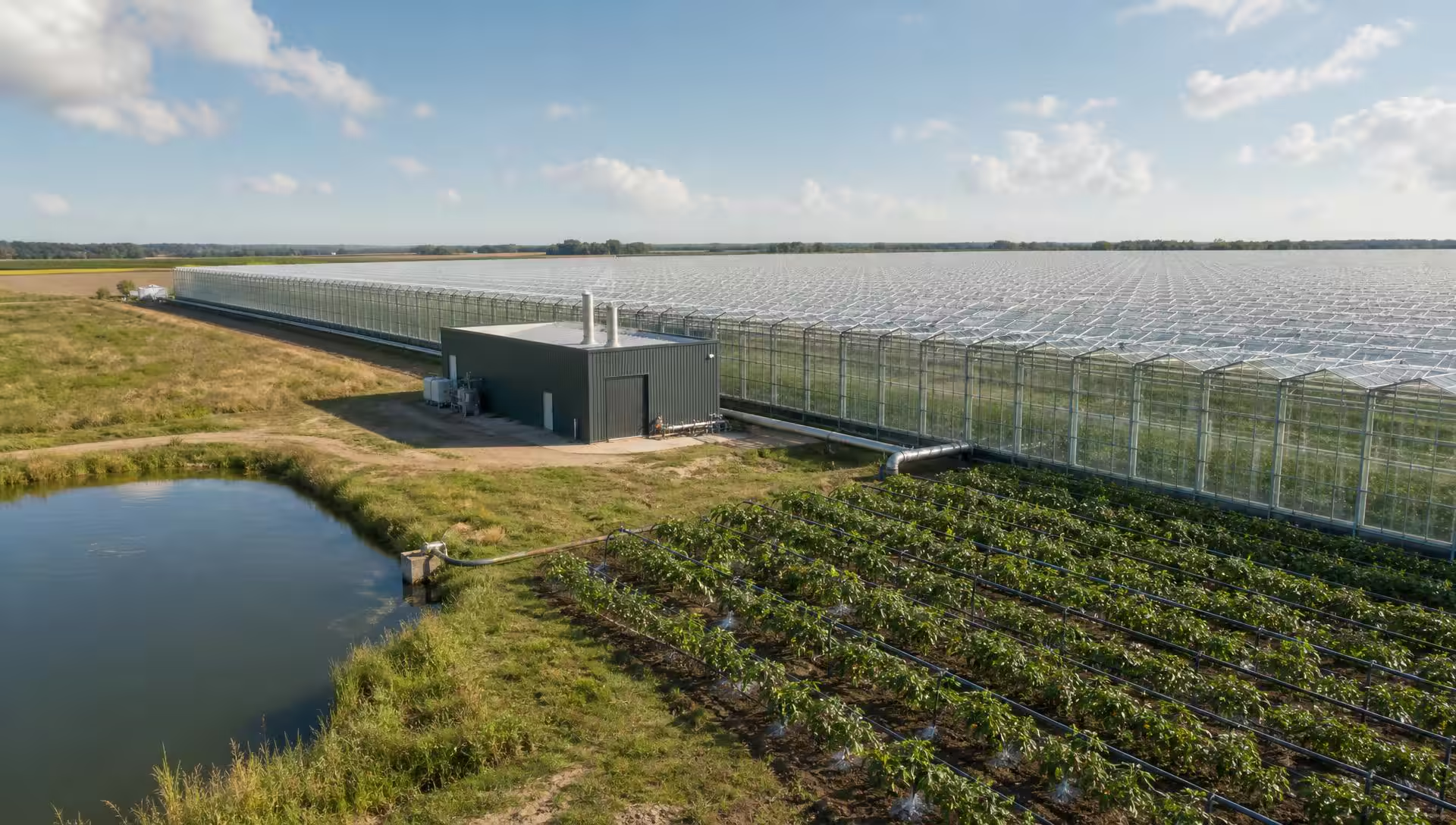
Live · Industrial Thermal Infrastructure
Thermal Power · Operational Economics Model
One deployed vertical within the YBG industrial thermodynamic intelligence platform.
Remote
No site visit · No hardware
Historian
Read-only · No DCS authority
Deterministic
Audit-grade · Reproducible
What Is ControlAlign™

A deterministic thermal-performance intelligence framework that reconstructs plant operational behaviour from historian data — to identify thermal drift, quantify fuel-performance loss, and support operational stabilisation.

ControlAlign™ does not modify your control system. It interprets the operational record you already produce — reconstructing thermal-state behaviour, quantifying departure from best demonstrated performance, and returning operator-actionable guidance under a deterministic, audit-reviewable methodology.

01
Historian-Derived Operational Diagnostics
Read-only ingestion of existing historian exports. No DCS authority. No instrumentation change.
02
Thermal-State Drift Reconstruction
Deterministic reconstruction of furnace thermal-state behaviour and departure from best demonstrated operating envelope.
03
Fuel-Loss & Performance-Gap Quantification
Quantified, audit-traceable estimation of the economic gap between current operation and the unit's own best demonstrated performance.
04
Operational Guidance & Optional Monitoring
Operator-native interpretive output, with optional ongoing fleet-level monitoring under the same deterministic framework.
Operational Pipeline
01
Historian Export
Read-only operational record
02
Deterministic Interpretation Engine
Reproducible methodology — no model drift
03
Thermal-State Reconstruction
Furnace behaviour & best-state envelope
04
Operator Guidance & Monitoring
Operator-native output · optional fleet view
Why Existing DCS / APC Systems Miss This

Conventional control architecture manages stability. It does not interpret radiative thermal-state quality.

Existing DCS and APC layers were engineered to maintain combustion and control stability — and they perform that role well. They were not, however, designed to explicitly interpret the radiative dimension of furnace operation.

What DCS / APC Manages
  • Combustion stability and loop control
  • Setpoint tracking and constraint handling
  • Process variable regulation
  • Operator interface and alarm management
What ControlAlign™ Interprets Above It
  • Effective flame emissivity behaviour
  • Radiative heat-transfer coupling quality
  • Furnace thermal-state reconstruction
  • Operational drift from best demonstrated radiative performance

ControlAlign™ is an interpretive operational intelligence layer above conventional control architecture — not a replacement for it.

It coexists with existing DCS / APC environments while maintaining traceability, explainability, and engineering reviewability.

Operational Proof Architecture

Anonymised diagnostic outcomes from utility-scale thermal units.

Representative interpretive outcomes drawn from historian-derived diagnostic engagements. Unit identifiers are withheld under operational confidentiality; methodology is reproducible and audit-reviewable.

Example Unit Analysis
Subcritical · 250 MW · Coal
Operational issue
Sustained radiative-coupling degradation under part-load operation
Drift characteristics
Heat-rate drift of ~2.8% vs. unit's own best demonstrated state over 18 months
Estimated recoverable value
≈ ₹42 Cr / year recoverable fuel value
Interpretation outcome
Operational stabilisation guidance + radiative-state monitoring window identified
Example Unit Analysis
Supercritical · 660 MW · Coal
Operational issue
Furnace thermal-state asymmetry across burner elevations
Drift characteristics
1.6% fuel-intensity variance vs. best demonstrated operating envelope
Estimated recoverable value
≈ USD 6.4 M / year recoverable fuel value
Interpretation outcome
Load-dependent operating envelope reconstruction; APC supervisory layer left untouched
Example Unit Analysis
Industrial Process Heat · Continuous Combustion
Operational issue
Drift in effective flame emissivity under variable feedstock blend
Drift characteristics
Thermal-state stability index declined 22% vs. historical baseline
Estimated recoverable value
Emissions-intensity recovery + ~3.1% specific fuel reduction
Interpretation outcome
Operator-native guidance band; deterministic re-stabilisation pathway documented
Drift Reconstruction · Indicative
Best demonstrated state · 0%Heat-rate departure (%)Operating months (indicative)Observed driftPost-stabilisationBest demonstrated

Indicative reconstruction of unit operation against its own best demonstrated state. Each engagement produces a unit-specific deterministic interpretation, not a generalised model output.

Layered Enterprise Information Architecture

Descend from executive outcome to engineering doctrine at your own depth.

Visitors progressively descend into deeper technical detail without being forced into it immediately. Each layer is independently coherent and audit-reviewable.

Institutional Trust Architecture

Engineering-reviewed leadership. Infrastructure-grade methodology. Audit-oriented standards alignment.

Leadership & Doctrine
Dr. Peter Griffiths · CMD, YBG Group International
Framework founder and doctrine author. Field origin of the radiative heat-transfer observation underlying the ControlAlign™ interpretive framework.
Srinivas (Srini) Adibhatla · Enterprise Systems & Operational Integration Advisor
30+ years across Oracle manufacturing, planning, asset management, and enterprise operational ecosystems supporting industrial deployment of the framework.
Full leadership & timeline →
Methodology · Standards · Traceability
Audit-grade interpretive doctrine
Combustion-performance interpretation · Radiative heat-transfer optimisation · Historian-derived operational intelligence · Thermal-state reconstruction · Operational drift analysis.
Frameworks are deterministic, reproducible, and engineering-reviewable. Outputs are traceable to the operational record and aligned with regulatory and standards expectations for utility-scale thermal assets.
Enterprise Engagement Pathway

A structured operational onboarding framework — not a software signup funnel.

Each stage is independently reviewable and may conclude an engagement on its own terms. Movement to the next stage is operationally justified, not commercially obligated.

  1. Stage 01
    Quick Estimate
    Low-friction recoverable-value indication using unit-class assumptions.
    Run estimate
  2. Stage 02
    Request Operational Assessment
    Submit historian sample under read-only, no-DCS-authority conditions.
    Begin assessment
  3. Stage 03
    Operational Diagnostic Review
    YBG deterministic interpretation, returned within 24–48 hours of data receipt.
    Review process
  4. Stage 04
    ControlAlign™ Stabilisation Programme
    Operator-native guidance, drift-band monitoring, and best-state envelope alignment.
    Programme scope
  5. Stage 05
    Enhancement & Fleet Deployment
    Fleet-level thermodynamic intelligence and consortium / utility advisory expansion.
    Fleet positioning
Begin at Stage 02
Request an Operational Assessment
Read-only · No outage · 24–48 hour turnaround on historian sample.
Request Operational Assessment →
Positioning
Read this first

Is YBGGlobal.com a marketing site for HydroHub™ or oxyhydrogen equipment?

No. YBGGlobal.com / ControlAlign™ is a standalone operational thermodynamics intelligence platform. The interpretation is the product — historian-derived, read-only, deterministic, audit-grade. There is no hardware sale, no equipment deployment, and no combustion-modification engagement attached to this platform.

Separate engineering and combustion-enhancement activities are operated independently within the broader YBG Group at yullbrownsgas.com and are not part of any ControlAlign™ engagement.

Read full FAQ →
Who Uses ControlAlign™

Built for the operational teams responsible for industrial thermal performance.

ControlAlign™ is an operational intelligence layer for the engineers, operators, and asset managers accountable for fuel and energy intensity, thermodynamic stability, and unit-to-unit consistency across large-scale industrial thermal infrastructure — with thermal power as the deployed vertical and adjacent industrial heat, LNG, refining, CCS, and heavy-industry environments on the platform roadmap.

01 · Thermal Power Operators
Coal · Gas · Biomass
Identify and stabilise heat-rate drift across operating units using existing historian environments. No DCS modification, no outage, no hardware.
02 · Performance Engineers & O&M Teams
Operational drift visibility
Improve visibility into thermal-state stability, fuel-intensity variation, and best-achieved operating envelopes across continuously operating assets.
03 · Industrial Furnace & Kiln Operators
Cement · Steel · Process heat
Support operational efficiency and emissions performance across continuous-combustion industrial environments where thermal stability drives margin.
04 · Asset & Fleet Managers
Fleet thermal consistency
Improve fleet-level visibility into fuel-performance consistency, operational variance, and best-achieved operating states across multi-site historian environments.
05 · ESG & Carbon Strategy Teams
Deterministic operational data
Generate historian-derived, audit-grade operational datasets for fuel-intensity interpretation and emissions-performance reporting.
Where ControlAlign™ Becomes Immediately Useful

Operational environments where the platform delivers value from day one.

ControlAlign™ is most effective in historian-rich thermal environments where operational drift, fuel intensity, and thermal-performance stability are commercially significant.

  • Existing DCS and historian systems are already in place
  • Fuel cost, energy intensity, or heat-rate performance materially affects operating margin
  • Continuous-combustion assets operate under emissions pressure
  • Operators need improved visibility into thermal-performance drift
  • Management wants to sustain best-achieved efficiency without hardware retrofit
  • Fleet operators require deterministic operational reporting environments

Heat-rate deterioration often develops gradually while units continue appearing operationally stable. ControlAlign™ helps operators sustain historically demonstrated thermal performance using existing operational data.

Fleet Thermodynamic Operations

Operational thermal-state intelligence across the fleet

Live interpretation of steam-fuel ratio, thermal coupling effectiveness, and operational stability per unit. All values are read-only outputs of the deterministic engine.

FLEET-OPS · 06 UNITSSample interpretation snapshot · representative
U-01OPTIMAL
Plant North · Unit 01
660 MW · Supercritical
Steam/Fuel
6.42kg/kg
TCE
91.4%
Load
88%
U-02STABLE
Plant North · Unit 02
660 MW · Supercritical
Steam/Fuel
6.31kg/kg
TCE
89.7%
Load
84%
U-03DRIFT
Plant North · Unit 03
500 MW · Subcritical
Steam/Fuel
5.94kg/kg
TCE
84.2%
Load
79%
U-04WATCH
Plant South · Unit 01
600 MW · Supercritical
Steam/Fuel
6.12kg/kg
TCE
86.5%
Load
81%
U-05STABLE
Plant South · Unit 02
600 MW · Supercritical
Steam/Fuel
6.28kg/kg
TCE
88.9%
Load
86%
U-06DRIFT
Industrial Boiler 12
210 MW · Subcritical
Steam/Fuel
5.71kg/kg
TCE
81.0%
Load
73%
Thermal-State Dashboard

Engineering-grade interpretation surface

Each tile is a deterministic output of the interpretation engine. Same historian input, same interpretive result — across runs, across analysts, across audit reviews.

TSD-01 · STEAM/FUEL INTERPRETATIONT-00:00 · 24h
Steam/Fuel Interpretation
Load-banded steam/fuel ratio, blue stable envelope vs amber drift envelope.
FLEETU-01U-02U-03U-04
TSD-02 · THERMAL COUPLING EFFECTIVENESST-00:00 · 24h
Thermal Coupling Effectiveness
TCE evolution across the campaign window. Best-demonstrated band shaded.
FLEETU-01U-02U-03U-04
TSD-03 · DRIFT VS HISTORICAL BESTT-00:00 · 24h
Drift vs Historical Best
Per-unit deviation from each unit's own best demonstrated thermal state.
FLEETU-01U-02U-03U-04
TSD-04 · OPERATIONAL STATE TRANSITIONST-00:00 · 24h
Operational State Transitions
Stability, transient, and drift segments across the last 24 operational hours.
FLEETU-01U-02U-03U-04
Operational Architecture

Historian-derived thermodynamic interpretation pipeline

An enterprise systems architecture with bounded responsibilities at each stage. No control authority, no operational intervention, no model drift between runs.

01
Industrial Historian
  • OPC-UA
  • CSV / API
  • Native fidelity
02
Signal Ingestion & Validation
  • Schema map
  • Range check
  • Time alignment
03
Deterministic Interpretation Engine
  • Reproducible logic
  • No model drift
  • Versioned
04
Thermal-State Reconstruction
  • Coupling
  • Radiative
  • TCE
05
Operational Guidance Layer
  • Operator-native
  • Load-banded
  • Read-only
06
Fleet Intelligence
  • Cross-asset
  • Drift maps
  • Stability index
07
Audit & Reporting
  • MRV-grade
  • Traceable
  • Reviewable
Read-only · No DCS authority · Deterministic · Audit-reviewable
Deployment Model

Repeatable, fleet-scale onboarding

A fixed seven-stage workflow from first historian export to audit-grade carbon reporting. Identical at single-unit and national-fleet scale.

Step 01
Historian Data Submission
Existing historian export — no instrumentation, no outage.
Step 02
Signal Validation & Mapping
Schema map and time alignment to native fidelity.
Step 03
Thermal-State Reconstruction
Operating thermal-state behaviour rebuilt deterministically.
Step 04
Operational Drift Identification
Variance from best demonstrated state quantified.
Step 05
Guidance Layer Generation
Operator-native operating conditions, by load band.
Step 06
Monitoring & Fleet Intelligence
Continuous interpretation across multi-site historian.
Step 07
Audit & Carbon Reporting
MRV-grade, audit-reviewable emissions-intensity output.

ControlAlign™ identifies and quantifies performance drift using plant operating data.

This establishes the measurable gap between current operation and the unit's best demonstrated performance.

The initial objective is to stabilise operation and reduce variability across real operating conditions.

In some cases, further gains may be achieved by improving how heat is transferred within the furnace environment.

ControlAlign™ produces auditable, historian-derived operational guidance — not recommendations for equipment modification or capital expenditure.

Scope Definition

Deterministic Interpretive Layer

ControlAlign™ is a deterministic, historian-derived interpretive system. It reconstructs operational history, quantifies drift from best-demonstrated thermal states, and produces auditable operator guidance — without control authority, without hardware dependency, and without engagement ambiguity.

Start here

Request the Data Requirements Guide

We'll send you the ControlAlign™ Data Requirements & Preparation Guide — outlining the required historian data, fuel inputs, and simple DCS export steps. Once data is shared, we proceed directly with analysis.

Data treated as commercially confidential. We are happy to operate under a mutual NDA — including your standard format — before data exchange.
Initial operational assessment is subject to review, qualification, confidentiality framework, and mutual agreement.
Results within 24–48 hours of data receipt. No site visit required.
Alternatively, email directly to admin@ybgglobal.com · We also accept requests to view the sample diagnostic and operational control guidance reports before data submission.
What you provide
DCS or historian export. CSV format. Any additional operating records you're willing to share improve the analysis.
What you receive
Diagnostic Report quantifying the performance gap. Operational Control Guidance translating it into operator-level control conditions.
Basis for initial assessment
Subject to review, qualification, confidentiality framework, and mutual agreement. The intent is to determine whether a material thermodynamic performance gap exists under the asset's actual operating conditions before any structured programme is discussed.
Industry Applications

One physics layer. Applied across the world’s large-scale industrial thermal infrastructure.

Industrial efficiency is fundamentally a thermodynamic problem. Fuel intensity, parasitic energy load, emissions intensity and process stability are all downstream outcomes of how a facility actually transfers heat — and most large industrial assets operate persistently below their own best demonstrated thermodynamic state. ControlAlign™ reconstructs that state from existing historian data, wherever combustion, compression, steam, refrigeration, or process energy transfer occurs at scale.

Thermal Power
Coal · Gas · Biomass · Steam-cycle units
Deployed · Calculator above
LNG & Gas Processing
Liquefaction trains · compression infrastructure
On platform roadmap
CCS / CCUS
Parasitic load · capture-train thermal stability
On platform roadmap
Refineries & Petrochemicals
Fired heaters · reformers · cracking furnaces
On platform roadmap
Industrial Steam Systems
Process steam · cogeneration · utility boilers
On platform roadmap
Biomass & Waste-to-Energy
Variable-feedstock combustion environments
On platform roadmap
Fertilizer & Chemicals
Ammonia · urea · process heating systems
On platform roadmap
Cement & Steel
Kilns · reheat furnaces · large industrial combustion
On platform roadmap
Hydrogen & Energy Transition
Reformers · electrolysis balance-of-plant thermal
On platform roadmap

The Thermal Power Economic Impact Model above is one deployed operational application within a much broader thermodynamic intelligence platform — covering thermal-state intelligence, industrial energy topology, process thermal stability, emissivity-aware optimisation, radiative coupling, parasitic energy load reduction, thermodynamic drift, and historian-derived intelligence across industrial thermal ecosystems.

Two deliverables. One evaluation.

The diagnostic establishes the gap. The guidance tells your operators what to do about it.

The analysis is fully data-led and derived from the unit's own DCS historian data. It focuses on identifying the unit's best demonstrated operating envelope, quantifying any variance from that state, and translating observed conditions into operator-level control guidance.

Report 01 · Diagnostic
Performance gap quantified
Establishes the magnitude of any gap between current operation and the unit's own best demonstrated state — expressed in %, fuel, and annual cost. Auditable, engineer-verifiable, traceable to validated plant data.
Report 02 · Operational Control Guidance
Actionable operating conditions
Translates the diagnostic into the specific operating conditions under which best performance has historically been achieved. Operator-native units. No control system interaction. No hardware changes.
Engagement basis
The initial ControlAlign™ operational assessment — covering one asset, both reports — is subject to review, qualification, confidentiality framework, and mutual agreement. Any subsequent structured programme is established on the same commercial basis.
For ESG, MRV & Carbon Desks

If you are here for emissions reporting and MRV, start here.

ControlAlign™ provides an MRV-grade interpretive layer that ties operational thermal-state behaviour to emissions-intensity outcomes — traceable from historian source data through to audit-reviewable carbon performance reporting.

Read-only. Deterministic. Aligned to internal MRV, ESG, and engineering-committee review processes. YBG does not issue carbon credits and does not represent itself as a credit-issuing authority — the platform produces the underlying operational evidence that emissions-intensity reporting depends on.

Explore Carbon Intelligence →
Illustrative — 600 MW unit
~240,000
tCO₂ / year avoided at a sustained 3% efficiency improvement.
— Historian-derived emissions-intensity interpretation
— Traceable to source operational data
— Compatible with internal MRV / ESG review
Illustrative figure only. Site-specific outcomes depend on load profile, fuel, and current operating envelope.
The physics

The analysis centres on radiative heat-transfer effectiveness — the operating conditions under which thermal energy has historically been delivered, absorbed, and sustained more effectively within the process environment, without any increase in fuel input.

More effective heat transfer may potentially be achieved with less fuel input. Systems focused primarily on combustion efficiency may still miss substantial latent value associated with how effectively heat is transferred and absorbed throughout the thermal process environment. ControlAlign™ extracts this using historian-derived operational intelligence — a deterministic, repeatable framework derived entirely from your own data.

01
Observe
Live plant data interpreted at full native fidelity across all load conditions. No models. No external benchmarks.
02
Quantify
The unit's own best-achieved performance defined using a deterministic, repeatable framework. Gap expressed in operator-native units.
03
Verify
Results traceable, auditable, and reproducible by plant engineering teams without proprietary tools. Suitable for audit committees and EPC partners.
Strategic Frame

Fuel-Intensity Reduction Across Industrial Thermal Infrastructure

Industrial fuel intensity is increasingly becoming a strategic infrastructure variable. Across thermal power generation and high-temperature industrial systems, relatively small sustained improvements in thermal efficiency can represent material economic and emissions-intensity outcomes at fleet scale.

YBG's framework focuses on identifying fuel-value drift, reconstructing best demonstrated thermal operating states, and improving radiative heat-transfer effectiveness using historian-derived operational intelligence.

The objective is not merely combustion optimisation. It is improving how effectively thermal energy is transferred, absorbed, and sustained throughout the industrial process environment.

01
Thermal Power Plants
02
Steel Plants
03
Industrial Furnace Systems
04
High-Temperature Process Infrastructure

The future of industrial decarbonisation may increasingly involve recovering thermal performance already latent within existing infrastructure.

Recoverable value · 600 MW unit · 85% PLF · USD 60/t coal

What the gap is worth — before a single change is made.

1%
33,500 t coal / year
USD 2.01M / year
INR 16.6 crore / year
₹4.55 lakh / day
5%
167,500 t coal / year
USD 10.05M / year
INR 83.2 crore / year
₹22.8 lakh / day
Subcritical unit assumptions. 85% PLF. Indicative. FX: 1 USD = 83.2 INR. Without changing a single piece of equipment.
Performance gaps identified are evaluated not only diagnostically, but in terms of their potential recoverability.
Strategic Layer · Fleet-Scale Intelligence

From Unit-Level Drift To Fleet-Scale Infrastructure Value

Relatively small sustained fuel-intensity improvements can become strategically material at industrial fleet scale. YBG’s framework focuses on identifying recoverable thermal performance using historian-derived operational intelligence and radiative heat-transfer analysis.

Illustrative Fleet-Scale Example

Thermal Generation Fleet

~5 GW
Thermal Fleet
2.5%
Identified Fuel-Intensity Gap
~US$40M /year
Potential Recoverable Fuel Value
~1.8–2.0M tCO₂e /year
Indicative Avoided Emissions Intensity

Illustrative scenario for conceptual purposes only. Actual results depend on operating conditions, fuel characteristics, and verified historian analysis.

Illustrative Industrial Heat Example

Steel & Industrial Heat

15M tonnes /year
Coal-Equivalent Industrial Fuel Use
2.5%
Identified Fuel-Intensity Gap
~375,000 tonnes /year
Potential Recoverable Fuel
~US$37.5M /year
Potential Fuel-Value Recovery
@ US$100/t illustrative fuel pricing
~0.9–1.0M tCO₂e /year
Indicative Avoided Emissions Intensity

Illustrative scenario for conceptual purposes only.

At industrial scale, relatively small sustained thermal-efficiency improvements can become strategically material.

The future of industrial decarbonisation may increasingly involve recovering thermal performance already latent within existing infrastructure.

Commercial Alignment

Economically Rational at Utility Scale

ControlAlign™ engagements are structured relative to the measurable operational value identified within each generating unit.

In large thermal environments, even relatively small improvements in fuel intensity may correspond to substantial annual economic recovery.

YBG's commercial structure is therefore designed to remain materially small relative to the operational value unlocked — aligning long-term incentives between plant performance, operational stability, and service delivery.

Because ControlAlign™ derives its intelligence directly from plant operational history, the platform focuses on measurable operational recovery rather than theoretical optimisation targets.

This allows performance discussions to remain grounded in:

  • historically demonstrated plant behaviour
  • operational traceability
  • fuel-value recovery
  • and audit-aligned performance interpretation
Operational Scale Context

On large thermal units, relatively small efficiency improvements may correspond to multi-million-dollar annual fuel-value recovery.

Illustrative. Actual recovery depends on unit size, operating profile, fuel pricing, and verified historian analysis.

Commercial structures aligned to measurable operational value. Designed for economically material performance recovery.

Operational Architecture

How ControlAlign Works

Historian-derived operational intelligence for reconstruction, stabilisation, and optimisation of thermal performance.

ControlAlign workflow: Historian Extraction, Reference-State Reconstruction, Drift Identification, Operational Alignment, Radiative Optimisation Layer, Recurring Economic Verification

ControlAlign™ reconstructs the plant's own historical operating behaviour to identify superior thermal-performance states, quantify operational drift, align operation toward proven conditions, and continuously verify recurring economic recovery.

Explore the Architecture →Request Operational Assessment
Methodology

Interpretive Disciplines

ControlAlign™ is built around a defined set of deterministic interpretive disciplines applied to historian-derived operational data. Each discipline is reproducible and audit-reviewable.

01
Thermal-State Interpretation
Reconstruction of operating thermal-state behaviour from historian signals at native fidelity.
02
Steam-Fuel Interpretation
Interpretation of the steam-fuel ratio as a consequence of underlying thermodynamic transfer behaviour.
03
Radiative Coupling Behaviour
Interpretation of how effectively combustion-generated thermal energy radiatively couples to working-fluid surfaces.
04
Thermal Coupling Effectiveness (TCE)
A deterministic measure of how completely thermal energy released by combustion becomes usefully absorbed heat.
05
Historian Reconstruction
Time-aligned reconstruction of operating state from native historian, OPC-UA, and CSV environments.
06
Best Demonstrated Performance
Identification of the operating envelope under which the unit has historically delivered its strongest thermal performance.
07
Deterministic Interpretation Framework
Same input data always yields the same interpretive result. No analytical drift across runs.
08
Operational Drift Detection
Continuous interpretation of deviation between current operation and demonstrated best thermal-state behaviour.
Trust & Governance

Operationally Constrained by Design

ControlAlign™ is engineered to operate strictly as a remote interpretive layer. The platform never holds control authority over plant equipment, never modifies control logic, and never intervenes in operations.

Historian-only ingestion
Operates from existing industrial historian environments. No new instrumentation required.
Read-only analysis
All analysis is read-only. The interpretation engine cannot write to plant systems.
No DCS control authority
No control authority over distributed control systems, actuators, or set-points.
No operational intervention
No external operator commands. Operating discipline remains entirely with the plant team.
Traceable calculations
Every interpretive output is reproducible from the underlying historian record.
Audit-grade methodology
Methodology is documented, deterministic, and reviewable by plant engineering, audit, and assurance functions.
Data confidentiality
Operating data is treated as commercially confidential. Mutual NDA arrangements supported.
OPC-UA / historian compatibility
Native compatibility with standard industrial historian and OPC-UA environments.
Operationally constrained interpretation
Interpretive scope is bounded to thermal-state behaviour and operational coupling — never operational authority.
Deliverables

Operational Intelligence Outputs

Each deliverable is generated from the same deterministic interpretation engine and presented in audit-reviewable form.

Deliverable
Thermal-State Reports
Reconstructed thermal-state behaviour across the operating envelope, with coupling and absorption interpretation.
Deliverable
Fuel Drift Reports
Quantified fuel-intensity drift between current operation and best demonstrated thermal state.
Deliverable
Fleet Performance Reviews
Cross-asset thermal performance interpretation across multi-site historian environments.
Deliverable
Operational Guidance Reports
Operator-native operating conditions correlated with the plant's strongest historically demonstrated performance.
Deliverable
Carbon MRV Reports
Audit-grade emissions-intensity interpretation traceable to historian-derived thermal behaviour.
Deliverable
Thermal Stability Assessments
Interpretation of thermal-state stability across load conditions, transient regimes, and operating campaigns.
Doctrine

The YBG Performance Doctrine

A deterministic interpretation framework for thermal-state behaviour, fuel-intensity drift, and radiative coupling within existing thermal infrastructure — derived entirely from industrial historian environments.

Privileged & Commercial-in-Confidence

YBG Performance Doctrine

Operational Performance Intelligence for Existing Thermal Fleets

Executive Summary

Most thermal generating units have already demonstrated materially stronger fuel performance within their own operating history.

The challenge is not whether this performance exists. The challenge is identifying:

  • how frequently the unit operates outside its best demonstrated state,
  • how much fuel value is lost during this deviation,
  • and whether this performance can be consistently stabilised and extended.

YBG's performance framework was developed around this operational reality. Using existing plant operating data, ControlAlign™ identifies measurable fuel-value drift relative to best demonstrated operation across real load conditions.

This creates a deterministic and auditable basis for operational alignment, performance stabilisation, and quantified economic evaluation.

Where appropriate, further gains may be achieved through enhancement of furnace radiative heat-transfer behaviour.

This framework forms the basis of the YBG Performance Intelligence architecture.

Continues — 12 further sections, glossary, and appendix
Full document

Operational Thermodynamics Doctrine

Includes:

  • Deterministic interpretation framework
  • Thermal-state reconstruction methodology
  • Fuel-intensity drift interpretation
  • Radiative coupling & TCE positioning
  • Historian-derived operational architecture

The full doctrine is openly available — no submission required. Institutional methodology framework for historian-derived thermal-state interpretation.

Download PDF ↓
Explore the full Methodology →
Operating a thermal fleet? Request an operational assessment — optional, and not required to access the doctrine.