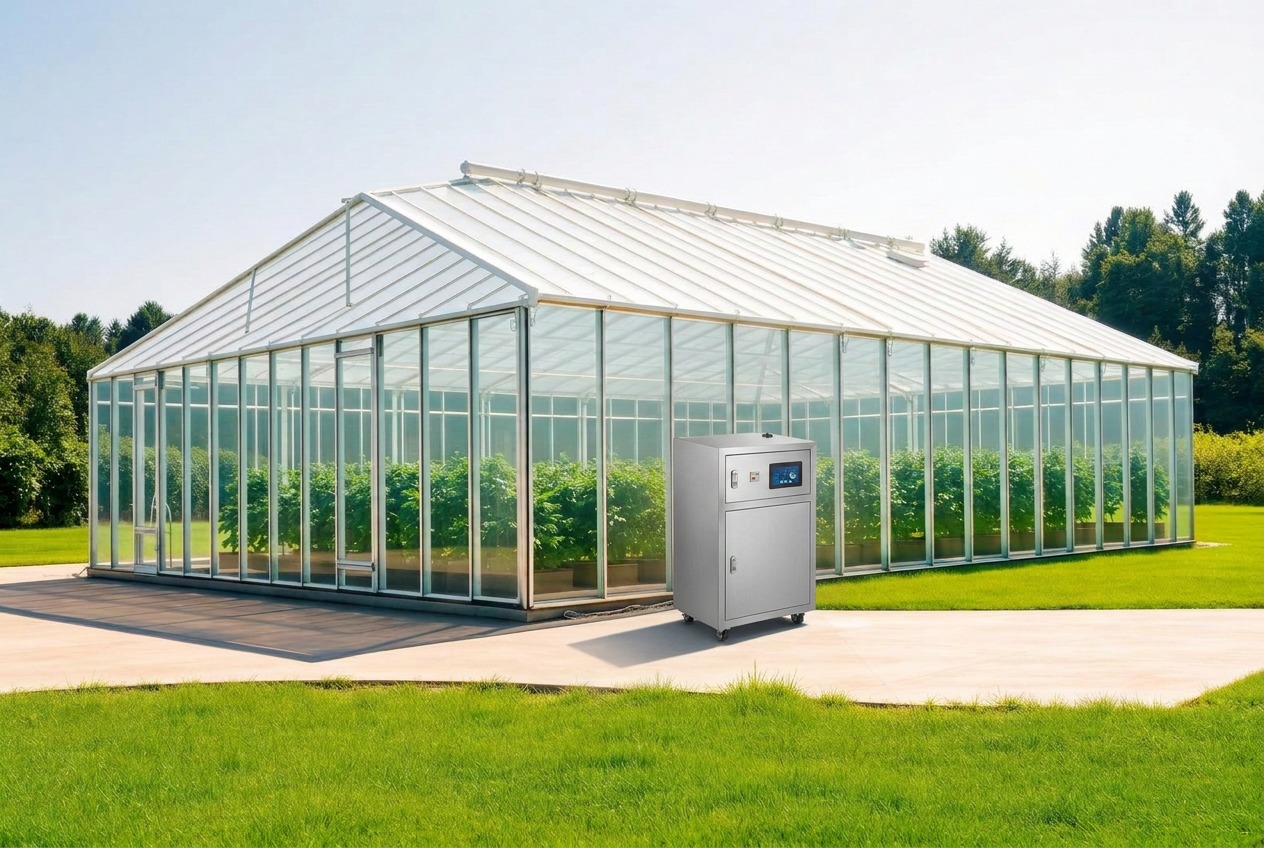
Hydrogen-rich Water for Nurseries & Propagation
A nursery sells establishment. Every tray, tube and container that leaves the gate carries the value of its root system — and the margin in the business lives in uniformity: thousands of plants reaching the same specification at the same time. HERO Irrigation treats the one input every plant shares: the water.
US$16,311 worldwide — DDP to selected destinations, DAP elsewhere, remote-guided commissioning included. Order directly on the HERO Irrigation product page.
One water treatment, every plant on the site
Production nurseries concentrate more plant value per square metre than almost any other growing operation — propagation houses, container yards and bed-grown stock all irrigated from common mains. That concentration is exactly why treating the water is leverage: one in-line unit upstream of your existing infrastructure reaches every zone it feeds.
The HERO Irrigation Hydrogen Nano-bubble System generates hydrogen by PEM/SPE electrolysis at 99.99% purity and dissolves it into the irrigation stream as sub-micron bubbles — 20 L/min of hydrogen-enriched water at 3,000–5,000 ppb dissolved hydrogen (sensor-verified). Sub-micron bubbles stay in suspension far longer than conventionally aerated water, delivering hydrogen to the root zone of container media and bed-grown stock alike.
This is the global direct-purchase channel. You order at a fixed USD price with self-serve checkout, the system ships DDP to selected destinations or DAP elsewhere to your nursery, and commissioning is remote-guided by the engineering team that built it. No distributor chain, no site-visit quote process — unless you want one.
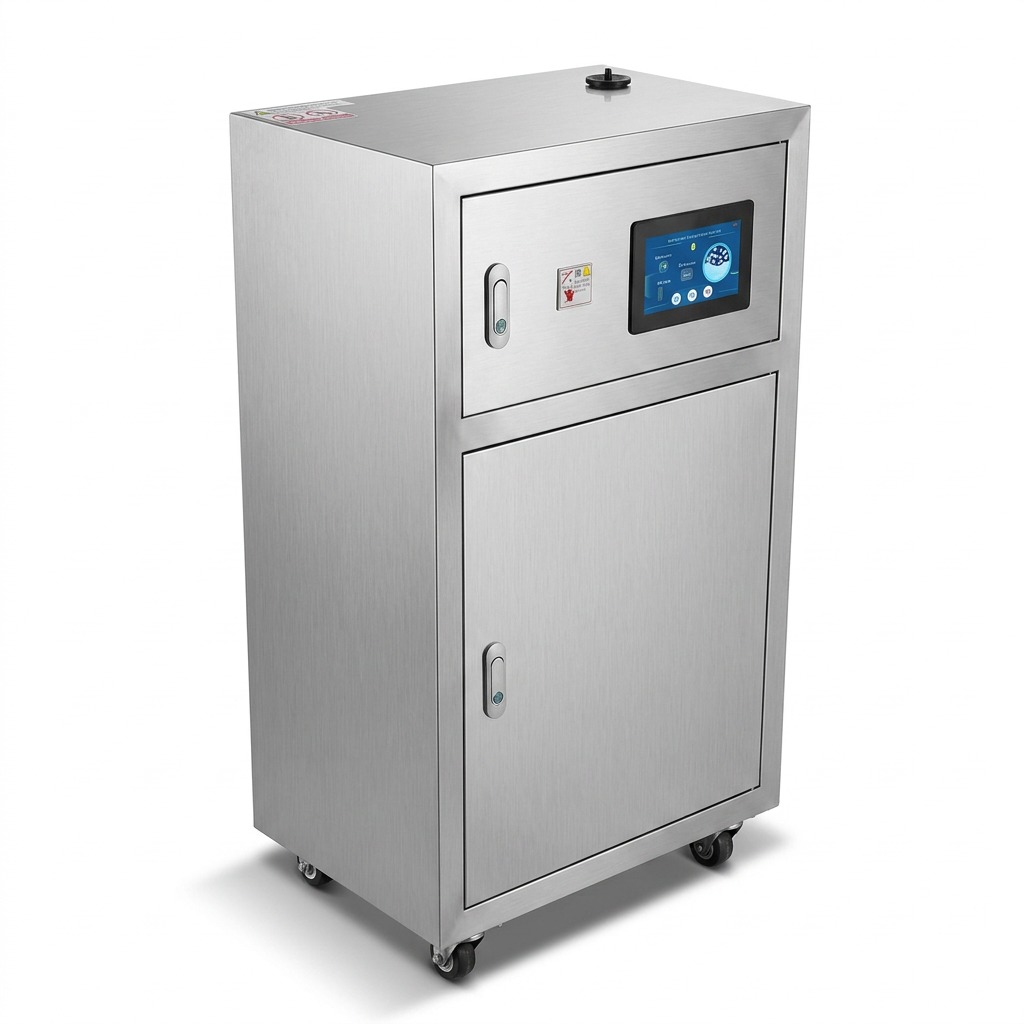
Model WZ-S · 550 × 350 × 970 mm · 83 kg incl. accessories · IP54 · CE and EMC (2014/30/EU) compliant
Why nurseries specify it
Head-house sized
A 550 × 350 mm footprint, 970 mm tall, on casters — sized for tight pump rooms and head houses, not just open plant rooms. 83 kg (including accessories), stainless steel, CE and EMC (2014/30/EU) compliant.Nothing downstream changes
Emitters, drippers, boom and overhead lines, dosing and fertigation equipment all stay exactly as they are. The unit connects in-line with the pressurised main and adds hydrogen to the water — full stop.Continuous duty across production cycles
Rated for 24/7 operation at 800 W from a standard single-phase supply. It runs through propagation cycles, peak season and winter production without scheduling or supervision.Scales with the site
One unit serves drip-irrigated deployments up to approximately 10 hectares. Nurseries running multiple independent mains or separated production areas add a unit per main — sized with the engineering team before ordering.Deployment at a production nursery
Installation is a single in-line tee into the pressurised main at the pump room or head house. Your own maintenance crew completes it with our engineers on a guided video call — commissioning is included in the US$16,311 price, and there is no production shutdown to schedule around.
Freight is Delivered Duty Paid where available: the listed price covers the unit, international freight, import duties and customs handling to your site. Where DDP is unavailable for your country, transparent DAP terms are quoted before you commit.
For nurseries running recirculating or closed-loop irrigation, contact the engineering team before ordering — the system's in-line design suits pressurised mains, and we will confirm the right placement for your hydraulics rather than leave it to assumption.
What the trial record shows
A two-year peer-reviewed controlled study on cherry tomato in China (Shanghai 2021, Nanjing 2023; Li et al. 2024, Plants 13(3), 443, doi:10.3390/plants13030443) recorded significantly higher yield and single-fruit weight than a conventional-fertiliser control group — and, most relevant to propagation, improved root-zone microbial activity in the treated crop.
A six-year programme on rice in Qingpu, Shanghai — run jointly with an industrial partner and an agricultural university (industry partner programme, not peer-reviewed; no public source on file) — recorded an average yield increase of 18.8% with reduced lodging and disease incidence across the programme.
These are reported trial results, not a guarantee of nursery outcomes — commercial results vary with crop, media, climate and practice. The full evidence file, with sources and an honest note on evidence quality, is maintained at hydrogenmachines.com.au/HERO-Irrigation.
The HERO Irrigation Hydrogen Nano-bubble System for nurseries: 20 L/min hydrogen-enriched irrigation water at 3,000–5,000 ppb, in-line with your existing mains — US$16,311 worldwide (DDP to selected destinations, DAP elsewhere) with remote-guided commissioning, available to order online.
HERO Irrigation for nurseries — FAQ
Does it work with our existing dosing and fertigation equipment?
Can it serve a recirculating irrigation system?
How much of the nursery does one unit cover?
What are the purchase terms?
What are nanobubbles in irrigation?
How do hydrogen nano-bubbles differ from oxygen nanobubbles?
Do nano-bubbles improve water infiltration?
Are nano-bubbles used in CEA and hydroponics?
How stable are hydrogen nano-bubbles?
Can nano-bubbles be used in turf management?
What is inline nano-bubble injection?
How do nano-bubbles support root-zone conditions?
What is the difference between micro-bubbles and nano-bubbles?
Is nano-bubble water activation the same as water treatment?
Hydrogen Nano-bubble Technology in Irrigation & Water Treatment
A nanobubble is a gas bubble small enough — typically well under one micron — that buoyancy no longer governs its behaviour. Instead of rising and venting like the coarse bubbles of conventional aeration, nanobubbles stay dispersed throughout the water column, held in suspension by surface charge. That dispersion is what distinguishes a nanobubble generator from a diffuser: the gas is carried with the water, through the pump, the filter bank, the mains and the emitters, rather than escaping at the point of injection. Nano-bubble stability, nano-bubble density and nano-bubble retention are the three properties that decide whether a nanobubble process survives a full irrigation cycle.
The established use of nanobubble technology in horticulture and water treatment is oxygen, air or ozone. Oxygen and air nanobubbles are used for water oxygenation and root-zone oxygenation — lifting dissolved oxygen in recirculating nutrient solution, tanks and reservoirs, and in aquaculture oxygenation. Ozone nanobubbles are used for water remediation and irrigation water treatment, where an oxidant is the objective. These are gas-delivery duties: the gas is consumed, oxidises, or off-gasses, and the effect ends with it.
HERO Irrigation works on the advanced modality — molecular hydrogen delivered by nano-bubble infusion. Hydrogen is the smallest molecule, so it disperses further and holds longer in suspension than the heavier gases used in oxygen or air systems, and it is not an oxidant: it does not scavenge, bleach or react with nutrient chemistry. Hydrogen is delivered by inline nano-bubble injection on a pressurised main — pump-inline dosing with no tank, no storage vessel and no change to driplines, emitters, dosing or the climate computer — and travels as dissolved hydrogen at 3,000–5,000 ppb (sensor-verified; 2,000–4,000 ppb by methylene-blue titration) to the root zone. This is why hydrogen nano-bubble water activation is specified in glasshouses, nurseries, vineyards, turf, hydroponics and vertical farming, where the irrigation line is the only reliable route to every root zone in the block. On evidence: the strongest documentation is instrumented — hydrogen concentration, purity, output and in-line stability are measured and certified. Grower-reported crop and turf outcomes across deployed sites are moderate, observational evidence. Long-horizon, multi-season yield modelling remains an open gap, and YBG Global states it as one rather than filling it with claims.
One engineering team, checkout to commissioning
One unit at the main reaches every zone it feeds — order online, DDP/DAP to your gate, commissioned with our engineers.