Hydrogen-Rich Irrigation for Australian Vineyards
Planning for a drier growing future
Peer-reviewed climate modelling published in Nature Reviews Earth & Environment finds that up to 65% of traditional Australian vineyard land could become climatically unsuitable under high-warming scenarios, with droughts projected to increase in frequency across the country's wine regions in the decades ahead. The Australian wine industry is already investing in resilience — rootstock selection, drought-tolerant cultivars, and irrigation efficiency — to adapt to a drier future.
Peer-reviewed climate modelling in Nature Reviews Earth & Environment finds up to 65% of traditional Australian vineyard land could become climatically unsuitable under high-warming scenarios, with droughts projected to become more frequent across Australian wine regions. HERO Irrigation installs in-line on an existing drip network and delivers 20 L/min of water at a sensor-verified 3,000–5,000 ppb of dissolved hydrogen, covering roughly 10 hectares per unit. Delivery to Australia is DDP — duties and taxes prepaid — and YBG Global makes no yield promise.
A technological response to water stress
Nano-bubble hydrogen-rich irrigation water improves water-use efficiency and plant stress resilience — a practical, deployable step toward the water-efficiency measures Australian viticulture is being urged to adopt now.
HERO Irrigation generates hydrogen on site by PEM/SPE electrolysis: the 99.99% purified hydrogen stream is dissolved as nano-bubbles into your existing irrigation main at a sensor-verified 3,000–5,000 ppb. Nano-bubbles — below roughly 200 nanometres — carry negligible buoyant lift, so they stay in suspension and travel through the pump, filter bank and emitters instead of venting in the mixing tank.
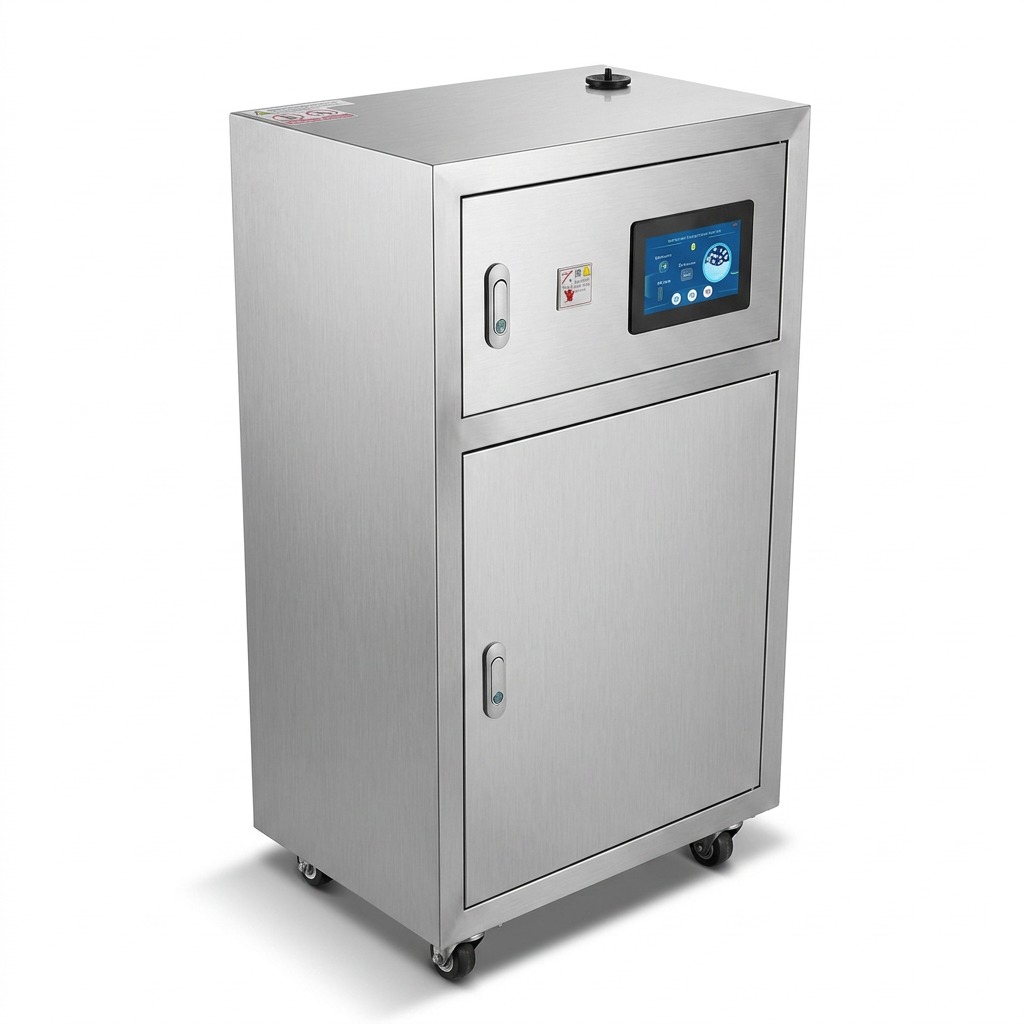
Installation is in-line on the existing network: 20 L/min of hydrogen water, around 10 hectares of drip coverage per unit, 800 W single-phase supply, stainless cabinet 550 × 350 × 970 mm, 83 kg including accessories, IP54, CE and EMC (2014/30/EU) compliant. No change to your fertigation regime is required — hydrogen is an additional parameter, measured and logged separately.
Pure hydrogenation — nothing added, nothing left behind
Our systems use PEM (Proton Exchange Membrane) electrolysis to split water directly into hydrogen and oxygen using an electrical current — no magnesium, minerals, or chemical additives are introduced at any stage. What goes into the irrigation line is water enriched with dissolved hydrogen, and nothing else.
For irrigation specifically, this matters: methods that rely on mineral or chemical reactions to generate hydrogen can leave residues in the water — a real consideration for soil chemistry, root-zone health, and long-term vineyard management. Electrolysis-based hydrogenation avoids that question entirely, delivering hydrogen-enriched water with no additive residue to account for.
Lower input costs, not just higher yield
Field data on hydrogen-rich water irrigation points to a second, independently significant benefit alongside yield: a real reduction in fertiliser dependency.
In open-field trials across Shandong and Hebei, China, growers using electrolytic nanobubble hydrogen-locking irrigation reduced chemical fertiliser and pesticide consumption by more than 30%, alongside a 12–25% yield increase and measurable improvement in soil acidification and hardening.
A separate, peer-reviewed two-year cherry tomato trial (Li et al., 2024, Plants) found something sharper still: hydrogen nanobubble water applied without any fertiliser at all produced higher yield, sugar–acid ratio, and lycopene content than a conventional fertiliser-only control group. In other words, the hydrogen treatment didn't just reduce how much fertiliser was needed — in this trial, it outperformed fertiliser entirely.
For growers facing rising input costs, this points to hydrogen-rich irrigation as a genuine input-cost lever, not only a yield or quality improvement.
Read the full case study: can hydrogen-rich irrigation reduce fertiliser use? →
Model WZ-S · 550 × 350 × 970 mm · 83 kg incl. accessories · IP54 · CE and EMC (2014/30/EU) compliant
Trial data, on the record
Hydrogen-rich water irrigation has been studied across a range of crops and trial designs. These are the two strongest data points on file — independently run, and verifiable at the source.
Rice — Qingpu, Shanghai
Run jointly with an industrial partner and an agricultural university, recording an average yield increase of 18.8% with reduced lodging and disease incidence across the programme. Industrial field-demonstration programme, not journal peer review — no public citable source is on file.Cherry tomato — two-year controlled study
Yield per plant up 39.7% and 26.5% in the 2021 Shanghai trial and 39.4% and 28.2% in the 2023 Nanjing trial against conventional-fertiliser controls, with improved fruit quality and root-zone microbial activity.Source: Li et al. (2024), Plants 13(3), 443 — doi:10.3390/plants13030443These are independent trial results, not a yield guarantee — commercial outcomes vary with crop, climate and growing practice. The full evidence file, with sources and an honest note on evidence quality, is maintained at hydrogenmachines.com.au/HERO-Irrigation.
Published research on hydrogen-rich irrigation water is early-stage and study-specific. Trial figures on this page are reported outcomes from the trials named, not projections for your site. No yield, disease, plant-health or therapeutic claims are made.
What comes with every order
- DDP delivery to Australia — duties and taxes prepaid, no import charges on arrival.
- Full technical documentation with every order (commercial invoice, HS code, certifications).
- Pay by card or bank transfer (proforma invoice available on request).