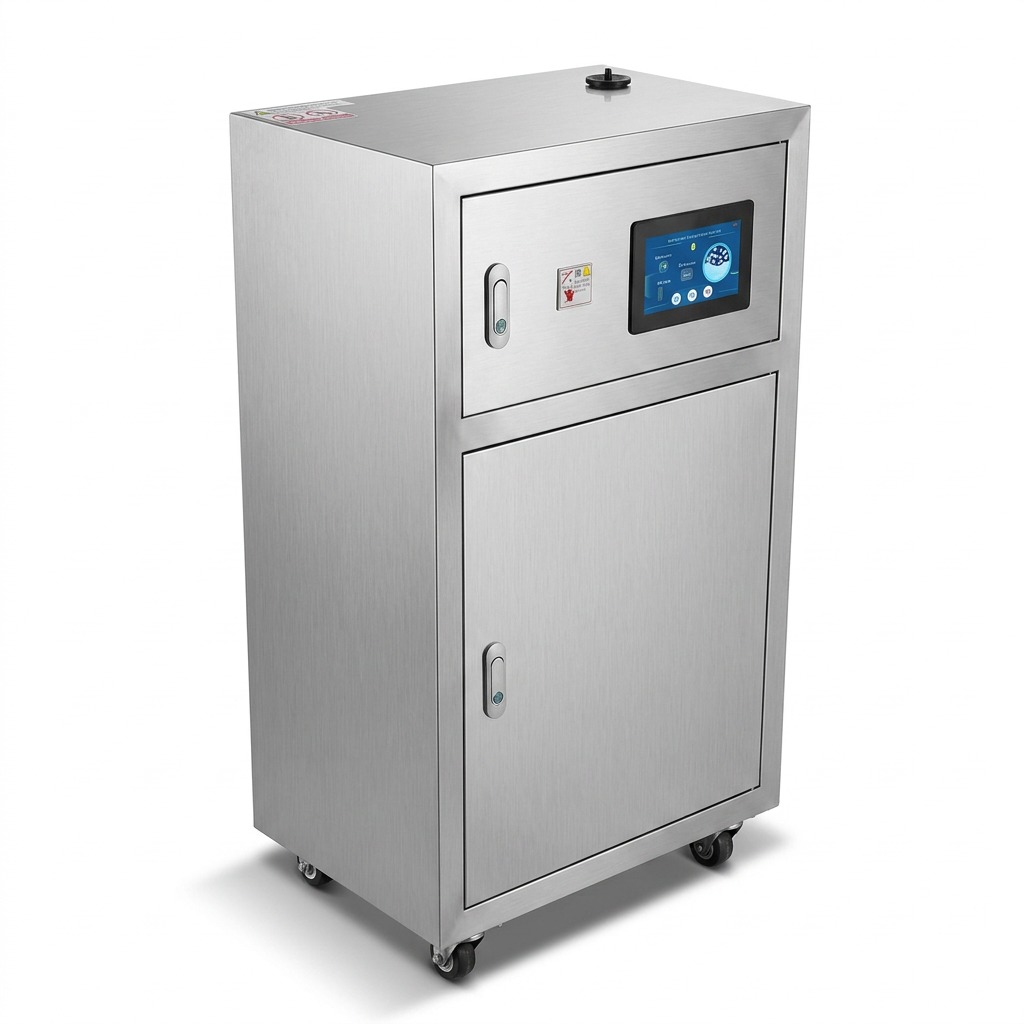
Hydrogen-Rich Irrigation for Commercial Vineyards
A water-quality addition to the drip system you already run. HERO Irrigation installs in-line at the head station and delivers dissolved hydrogen through your existing driplines and emitters — 20 L/min (5.3 gal/min) at 3,000–5,000 ppb, covering up to 10 hectares (about 25 acres) of drip-irrigated vineyard per unit.
Supplied worldwide by YBG Global at a fixed US$16,311 price — DDP to selected destinations (freight, duties and import handling included) or DAP elsewhere (freight included; import duties, VAT and customs handling payable by you on arrival). Remote-guided commissioning is included, by card or against a purchase order. Full product specifications live on the HERO Irrigation product page.
Secure checkout · 24-month warranty · 90-day refund
Warranty, refund & pre-dispatch verification — buying direct from the manufacturer's group
Unscripted output verification. A standard production unit running into a small vessel — the visible milky plume is the nano-bubble output itself, at the same 20 L/min and 3,000–5,000 ppb rated on the line. No edit, no narration, no studio. Full footage and context →
Every order is personally reviewed before dispatch. Not a queue and not a call centre: the founder checks your destination, supply voltage and in-line connection against the order, and follows up with you directly before anything ships. That is the advantage of buying from a small, accountable engineering operation rather than a distributor.
Performance
Physical
Installation & operation
Hydrogen-rich vineyard irrigation means dosing the irrigation stream with molecular hydrogen at nano-bubble scale, so water reaching the root zone carries 3,000–5,000 ppb of dissolved hydrogen (sensor-verified) instead of none. The HERO Irrigation WZ-S generates it on demand by PEM/SPE electrolysis at 99.99% purity and injects it in-line at 20 L/min (5.3 gal/min) on an existing pressurised drip main — one unit is specified for up to 10 hectares (about 25 acres). YBG Global makes no yield claim for vineyards: the machine's output, purity and in-line stability are instrumented and certified, while crop-response evidence is limited to reported trials in other crops (rice, cherry tomato) and observational grower reports. Multi-season vineyard yield data is an open gap and is stated as such.
5.3 gal/min (US)
sensor-verified
≈ 25 acres
≈ 1,585 gal/day (US)
100–240 V single-phase
Model WZ-S · 550 × 350 × 970 mm (21.7 × 13.8 × 38.2 in) · 83 kg incl. accessories (183 lb) · IP54 · CE and EMC (2014/30/EU) compliant
It adds to your drip system. It does not replace it.
YBG Global does not sell driplines, emitters or controllers, and does not ask you to change the ones you have. If your blocks run Netafim, Rivulis, Toro or any other commercial drip or micro-drip infrastructure, that stays exactly as designed. HERO Irrigation connects in-line on the pressurised main — normally at the head station, downstream of filtration — and treats the water passing through it.
No change to delivery hardware
Driplines, emitters, pressure-compensating hardware, filters, valves and block scheduling are untouched. Emitter selection and spacing remain your irrigation designer's decision.Fertigation and dosing untouched
Injection sits in-line on the main; your fertigation skid, dosing pumps and nutrient recipes continue to run as configured. Hydrogen is not an oxidant — it does not scavenge, bleach or react with nutrient chemistry.A different dimension, not a competing one
Irrigation-equipment incumbents compete on how water is delivered and metered. Dissolved hydrogen is a water-quality parameter none of them address — which is why this is an addition rather than a switch.Head-station footprint, single-phase power
550 × 350 × 970 mm (21.7 × 13.8 × 38.2 in), caster-mounted, 800 W from a standard single-phase supply — realistic for a remote pump house without a three-phase upgrade.Trial data, on the record
Hydrogen-rich water irrigation has been studied across a range of crops and trial designs. These are the two strongest data points on file — each labelled with its evidence standing.
Cherry tomato — two-year controlled study
Hydrogen nanobubble water raised yield per plant by 39.7% and 26.5% in the 2021 Shanghai trial and by 39.4% and 28.2% in the 2023 Nanjing trial, against conventional-fertiliser controls, with improved fruit quality and root-zone microbial activity. Li et al. (2024), Plants 13(3), 443 — doi:10.3390/plants13030443
Rice — Qingpu, Shanghai
Run jointly with an industrial partner and an agricultural university, recording an average yield increase of 18.8% with reduced lodging and disease incidence across the programme. Industry partner programme, not peer-reviewed; no public source on file.
These are reported trial results, not a yield guarantee — commercial outcomes vary with crop, climate and growing practice. The full evidence file, with sources and an honest note on evidence quality, is maintained at hydrogenmachines.com.au/HERO-Irrigation.
Both results above are drip- and irrigation-delivered trials in crops other than grapes, and they are reported here as trial data — not as a promise of what your blocks will do. No multi-season vineyard trial is on file. What is documented to instrument grade is the machine: dissolved-hydrogen concentration, 99.99% purity, output rate and in-line stability are measured and certified, and the mechanism is set out on the hydrogen nano-bubble technology page.
These trials measured dissolved molecular hydrogen specifically, not combined oxyhydrogen gas — the distinction is explained on hydrogen vs. oxyhydrogen for irrigation.
Pair irrigation with Climate Systems — something no irrigation supplier can offer
Many vineyard operations burn fuel as well as pump water: frost-protection heating, propagation and nursery glasshouses, barrel rooms, bottling lines and winery process heat. YBG Global's Climate Systems oxyhydrogen generators retrofit to an existing boiler's combustion-air stream — no burner replacement, no re-tubing, no stored gas — so one engineering team can address both the water side and the heat side of the estate.
Lower input costs, not just higher yield
Field data on hydrogen-rich water irrigation points to a second potential benefit alongside yield: lower fertiliser dependency.
A peer-reviewed two-year cherry tomato trial (Li et al., 2024, Plants) found that hydrogen nanobubble water applied without any fertiliser at all produced higher yield, sugar–acid ratio, and lycopene content than a conventional fertiliser-only control group. In other words, the hydrogen treatment didn't just reduce how much fertiliser was needed — in this trial, it outperformed fertiliser entirely.
For growers facing rising input costs, this points to hydrogen-rich irrigation as a genuine input-cost lever, not only a yield or quality improvement.
Read the full case study: can hydrogen-rich irrigation reduce fertiliser use? →
See the system running before you specify a vineyard block
HERO Irrigation Hydrogen Nano-bubble System in operation — the same unit supplied for vineyard and orchard drip lines.
Commercial vineyard buyer FAQ
Does this replace my existing vineyard drip system?
What evidence exists, and what is not claimed?
How much vineyard area does one unit cover?
Can HERO Irrigation be paired with climate-side equipment on a vineyard?
What is the order process for a purchase-order or committee buyer?
What power and site services does it need at a remote block?
One engineering team, checkout to commissioning
Buy by card at US$16,311 DDP, or request a pro-forma invoice for bank transfer against a purchase order. Use the landed-cost calculator above to see the delivered figure for your country before you commit.